What Is the Difference Between UFO and Linear High Bay?

Time:2026-10-17 Author:Sophia
0%

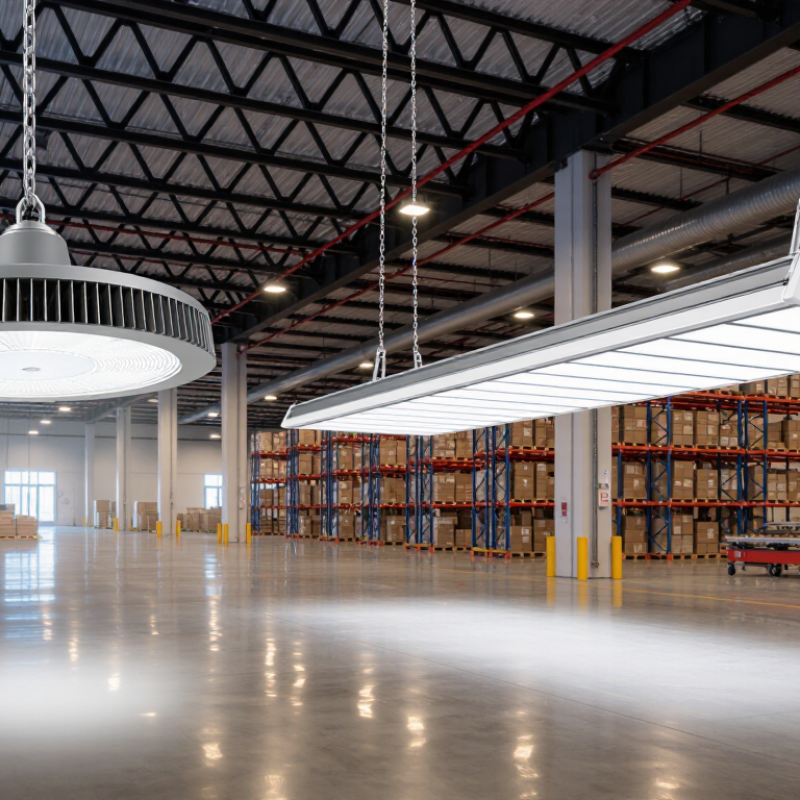
Choosing warehouse lighting often begins with one practical question: what is the difference between ufo high bay and linear high bay? The answer involves more than appearance. It includes beam distribution, mounting height, aisle geometry, glare, maintenance access, and energy performance. A round UFO fixture usually produces a broad, symmetrical beam from a compact housing. It suits open floor areas, workshops, gyms, and spaces with flexible layouts. A linear high bay spreads light along a longer optical path. It often works better above aisles, shelving rows, and production lines.

The U.S. Department of Energy’s LED market studies report that modern LED systems can deliver substantial energy savings compared with older high-intensity discharge technologies. The DesignLights Consortium also evaluates high-bay products through efficacy, controllability, and quality requirements. Yet reported lumens do not explain the entire result. A 20-foot ceiling, dusty lens, or poorly aimed fixture can change the visual experience. Small details matter. Very much.

Lighting pioneer Stanley McCandless stated, “The purpose of all lighting is to make things visible.” That principle remains useful here. UFO high bays can simplify installation and reduce visual clutter. Linear fixtures may improve uniformity across long work surfaces. However, neither shape is automatically superior. The wrong beam angle can create bright spots, dark shelving faces, or uncomfortable glare. Product specifications may also look better on paper than in a real warehouse. A careful comparison should examine photometric files, spacing plans, controls, color quality, and measured illumination. This article explores those differences with practical evidence, while recognizing that every facility has its own imperfect constraints.
What Is the Difference Between UFO and Linear High Bay?

What Are UFO and Linear High Bay Lights?

UFO and linear high bay lights are LED fixtures designed for tall commercial and industrial spaces. “UFO” describes a compact, round housing resembling a flying saucer. Its circular body usually places LEDs around a central heat sink. A linear high bay uses a long, rectangular housing with an extended optical surface. Think aisles, not circles. Both typically serve mounting heights above 15 feet, but ceiling layouts influence the better choice.

A UFO high bay often produces a broad, symmetrical beam for open floor areas, workshops, and sports spaces. Its compact shape can simplify mounting beneath exposed ceilings. A linear fixture spreads light lengthwise, supporting warehouse aisles, production lines, and shelving. Photometric files matter more than shape alone. The U.S. Department of Energy’s 2023 Solid-State Lighting R&D Opportunities report identifies commercial LED efficacy above 150 lumens per watt as a practical performance reference, although installed results vary. DesignLights Consortium technical requirements also assess efficacy, distribution, color quality, and controllability.

In a real facility, measure mounting height, aisle width, reflectance, and task illuminance before choosing. The Illuminating Engineering Society emphasizes maintained illuminance and uniformity, because bright points can still leave dark floor areas. This comparison is not always tidy. A UFO may look powerful but create glare under a low-reflective roof. A linear high bay may fit an aisle better, yet require careful spacing at intersections. Review IES recommendations and an independent photometric layout. Wattage alone does not prove a successful installation.

What Is the Difference Between UFO and Linear High Bay Lights?

This chart compares representative midpoints of commonly available LED high-bay specifications. UFO high bays use a compact circular housing and are often selected for open areas, while linear high bays provide a longer light distribution that suits aisles, racks, and rectangular workspaces. Actual performance varies by fixture design, optics, mounting height, and operating conditions.

How Do Their Designs and Beam Patterns Differ?

UFO and linear high bay fixtures differ most in optical design and beam behavior. A UFO uses a circular housing with a central LED board and reflector. Its light usually spreads in a round, symmetrical pattern. Common beam angles range from 60 to 120 degrees. This suits open warehouses, gymnasiums, and tall spaces with wide mounting zones. A linear high bay uses a long LED board with separate lenses. Its distribution is usually rectangular or batwing-shaped. The beam can push light across aisles while limiting waste between shelving rows.

The U.S. Department of Energy’s Solid-State Lighting reports show that modern LED high-bay systems commonly reach more than 130 lumens per watt. However, efficiency alone does not prove better illumination. IES RP-7 recommends evaluating industrial lighting by task, mounting height, spacing, glare, and maintained illuminance. A 90-degree UFO beam may create bright circles beneath fixtures. A linear optic can produce more even aisle lighting, but poor spacing may leave dark ends. That detail is often missed. Real installations can be less tidy than photometric plans suggest.

Tips: Check the photometric file, not only the fixture shape. For rack aisles, compare longitudinal and transverse distributions. For open floors, review uniformity and glare ratings. The DesignLights Consortium qualification data can help verify tested performance, but field conditions still matter. Dust, mounting height, and reflective surfaces can change the final beam pattern. A perfect layout on paper may need adjustment after installation.

Where Is Each High Bay Light Best Used?

What Is the Difference Between UFO and Linear High Bay?

A UFO high bay has a round housing and a concentrated beam. Its compact shape suits open spaces with tall ceilings, exposed structures, and wide equipment aisles. Installers often choose it for warehouses, workshops, gymnasiums, and agricultural buildings. A linear high bay uses a longer rectangular body. It spreads light more evenly along aisles, shelving rows, and production lines. The choice depends less on appearance than on ceiling height, mounting layout, beam angle, and required uniformity.

The U.S. Department of Energy reports that LED lighting can use at least 75% less energy than incandescent lighting and last up to 25 times longer. That comparison is not a direct high-bay test, but it shows why efficient LED fixtures matter in long-hour facilities. IES RP-7-20 also emphasizes task visibility, glare control, and uniform illumination for industrial spaces. UFO fixtures can create strong pools of light under high ceilings, yet poor spacing may leave dark zones between fixtures. Linear models usually perform better over continuous workstations and narrow aisles.

Think about the floor first.

A logistics aisle with 30-foot shelving may benefit from linear optics aimed down each row. An open machine shop may need UFO fixtures with carefully selected beam angles. Reflective metal surfaces can increase glare, even when measured illuminance looks acceptable. Photometric layouts should be checked before installation. In practice, mounting height and spacing often matter more than the fixture label. I have seen “simple” replacements produce uneven floors, so the round-versus-linear decision deserves a lighting simulation, not just a catalog comparison.

How Do Installation and Maintenance Requirements Compare?

UFO and linear high bays can both illuminate tall industrial spaces, but their installation demands differ. UFO fixtures are compact and usually mount from one point. They suit open floor plans with high ceilings and unobstructed aisles. Linear high bays need longer mounting hardware, suspension cables, or continuous rows. Their shape supports more uniform lighting over racks and production lines.

A field survey should happen before ordering. Measure ceiling height, beam spacing, aisle width, and existing junction boxes. The U.S. Department of Energy’s 2020 LED Lighting Facts database shows many listed LED products exceeding 100 lumens per watt, but efficiency alone does not guarantee good coverage. A linear layout can reduce dark zones between shelving. A UFO may create stronger shadows beneath tall equipment. That assumption can fail.

Maintenance access is equally important. UFO fixtures often allow quicker replacement because technicians reach one central housing. Linear systems may require checking several connected fixtures, drivers, lenses, and suspension points. The DOE’s 2019 Energy Savings Forecast projected LED lighting could reach 86% of general-illumination lumen-hours by 2035, increasing the importance of long-term service planning. Rated life still depends on heat, dust, voltage, and driver quality. Clean dusty lenses during scheduled inspections. Do not wait for visible failure. In my experience, crews often underestimate lift access, especially above active aisles. A lighting audit using IES RP-7-20 recommendations can reveal whether easier installation actually produces acceptable maintained illuminance.

Which Factors Determine the Right High Bay Choice?

Choosing between a UFO and a linear high bay depends on the building, not the fixture’s appearance.

A UFO high bay spreads light in a broad circular pattern. It suits open floors, workshops, and areas with flexible storage.

A linear high bay creates a longer distribution pattern. It often performs better above warehouse aisles, production lines, and shelving rows.

In a 12-meter warehouse, aisle direction and beam control can matter more than total lumens.

The U.S. Department of Energy’s 2023 Solid-State Lighting R&D Opportunities report lists 255 lumens per watt as a long-term white-light target.

That is a research benchmark, not typical installed performance. Compare tested efficacy, light distribution, glare, and thermal ratings.

DLC technical requirements also emphasize documented performance, lifetime, and controllability. Look beyond the label.

Mounting height changes the decision.

At six meters, a wide UFO beam may reduce dark patches across an open work area.

At twelve meters, a narrow or aisle-focused linear optic may place more light on the floor and racks.

The IEA’s 2023 Energy Efficiency report estimates that lighting uses about 15% of global electricity, so controls and operating schedules deserve attention.

Occupancy sensing can reduce wasted runtime, but poor sensor placement creates annoying delays.

A neat spreadsheet can still mislead. I would not choose solely by lumens; glare, maintenance access, dust, ambient heat, and future rack changes can quietly decide the better option.

FAQS

What is the main design difference between UFO and linear high bay lights?

UFO fixtures use round housings and central LED boards. Linear fixtures use long boards with separate lenses.

How do their beam patterns differ?

UFO lights usually create round, symmetrical beams from 60 to 120 degrees. Linear lights often create rectangular or batwing patterns.

Which fixture suits open warehouses or gymnasiums?

UFO fixtures often suit open floors, tall ceilings, and wide mounting zones. Their beams spread outward from each fixture.

Which fixture works better for narrow shelving aisles?

Linear fixtures usually direct light along aisles. They can reduce wasted light between tall shelving rows.

Does higher efficiency guarantee better lighting?

No. Efficiency does not prove good illumination. Spacing, glare, mounting height, and uniformity also matter.

What problems can poor fixture spacing create?

UFO fixtures may create bright circles below each unit. Dark gaps can appear between fixtures.

What should be checked before choosing a fixture?

Review the photometric file, beam angles, mounting height, and spacing. Do not judge performance by fixture shape alone.

How can reflective surfaces affect the result?

Metal shelving may increase glare. Dust and reflective floors can also change the final appearance.

Is a lighting simulation always reliable?

It is useful, but not perfect. Field conditions may require adjustments after installation.

How should a facility choose between the two designs?

Consider the floor layout first. A 30-foot shelving aisle may favor linear optics, while an open shop may favor UFO fixtures.

Conclusion

UFO and linear high bay lights are both designed for illuminating large, high-ceiling spaces, but their shapes and light distribution make them suitable for different environments. UFO high bays have a compact, circular design that produces a broad, generally symmetrical beam, making them a practical choice for open areas such as warehouses, workshops, and storage facilities. Linear high bays use a long, rectangular housing to provide a more extended and uniform distribution of light, which works well in aisles, production lines, retail spaces, and areas with organized rows.

When considering what is the difference between ufo high bay and linear high bay, installation space, ceiling height, layout, desired brightness, energy efficiency, and maintenance access are important factors. UFO fixtures are often easy to mount and maintain, while linear models may require more careful alignment to achieve consistent coverage. The right choice depends on the room’s dimensions, mounting arrangement, beam requirements, operating conditions, and long-term lighting goals.

Sophia

Sophia

Sophia is a dedicated marketing professional with an exceptional depth of knowledge about her company's products and services. With a keen understanding of market trends and customer needs, she crafts insightful blog posts that not only inform but also engage readers, enriching the company’s online......